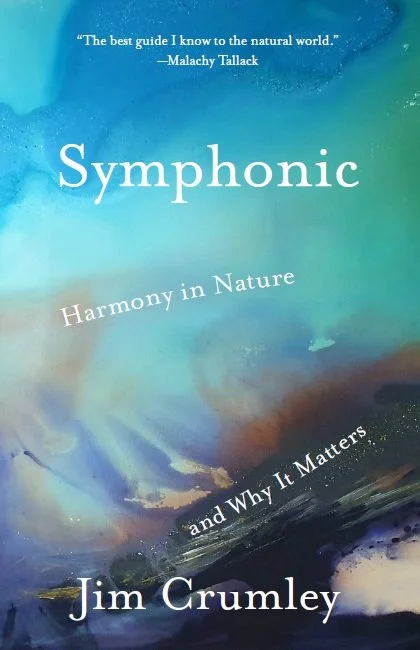
Symphonic
Harmony in Nature and Why It Matters
Published by Saraband on 12 February 2026
Extract from the Prologue: A Quest for Harmony
TO KEEP NATURE’S COMPANY is to hear it as well as to see it, to move to its rhythms and sing along. To listen to its themes and variations is to unearth its landscape. Long before the people were on the surface of the planet to listen to it, music began with the sounds of the Earth. Long after the people are extinct, that Earth music will go on without them. In the meantime, it seems to me that to write nature is a symphonic endeavour.
Symphonic. The word’s origins are Greek, from syn meaning together, and phone meaning voice or sound.
The English language acquired sinfonia a thousand years ago, meaning to sound or play together. Since then, the word has evolved into symphony, which spawned symphonic – the interweaving of themes or harmonious arrangements. It is the perfect definition of nature, and my own definition of how I fit into nature’s scheme of things, how nature dominates mine. Whenever I seek out nature’s company with a view to watching it at work, to think about what unfolds and to try and write it down, the interweaving of themes and harmonious arrangements becomes the endeavour of those hours. So the endeavour becomes symphonic, and Sibelius comes to mind. The symphonies of Sibelius are fashioned from the raw stuff of the landscapes of the north of the world and sometimes move to rhythms that recall the pulse of swans’ wings.
I wonder what that feels like, that capacity to be so attuned that the surge of swans in flight is plainly discernible when a composer like Sibelius writes down as musical notation what he hears in his head. Then it is as if a skein of swans lifts from the page.
J.M. Barrie, whose novels and other prose writings are undervalued to the point of being ignored in his native Scotland today, wrote in The Little White Bird:
“The reason birds can fly and we can’t is simply that they have perfect faith, for to have faith is to have wings.”
He made a fair point. For all the swans and eagles, kingfishers and swifts, falcons and owls that have urged my nature-writing endeavours through four decades and more than forty books, my faith in my own writing remains imperfect, and I remain earth-bound.
When I began writing books back in 1988, music along with art became the indispensable nourishment of the writing process after nature itself.
This book, then, is about a lifelong quest for harmony. Harmony in nature and harmony in a nature-writing life…
…The quest for harmony in nature and harmony with nature is as old as the human race’s taste for bards. This is an old row that we hoe, we nature writers of the twenty-first century.
We cannot communicate with nature by manipulating it, by fashioning our own idea of an imitation of it; that’s not how nature works. Rather we must watch and listen to the interactions it fosters in whatever way occurs to us, and take the time and trouble to respond thoughtfully.
Which is when we become better creatures and nature values our company more.
Which is when conversation becomes possible and nature begins to impart its concerns and its secrets.
Which is when we can begin to fall into step with nature, and sing along. Harmonising.
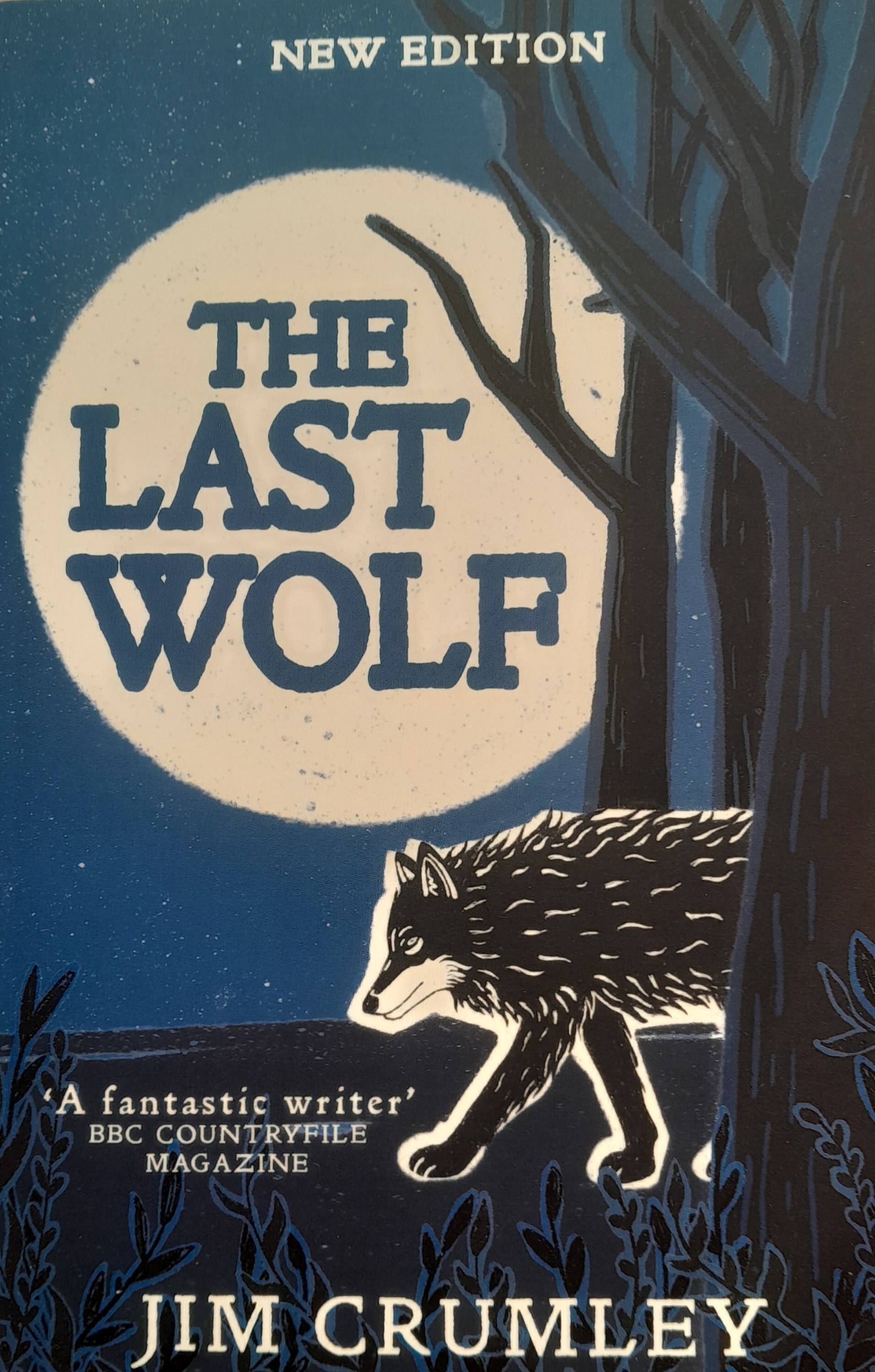
The Last Wolf
NEW EDITION
Published by Birlinn, February 2026
Extract from Introduction to the New Edition
The wolf landscape of mainland Europe has transformed since The Last Wolf was first published in 2010, and it goes on transforming. Westward expansion from strongholds in Eastern Europe, notably in Poland, has spread until now there are wolves in every mainland European country. If we still had a land bridge, they would be here.
My original ambition for The Last Wolf was threefold. Firstly, I wanted to rewrite the history of the wolf in Scotland. All that was written down was little better than fragments; worse, they were Victorian fragments, and these drenched the reputation of the wolf in bile compounded by ignorance….
…Secondly, I wanted to bring biological truths to bear, to show the wolf’s elevated place in nature, to suggest that the wolf is a creature to revere, not revile…
…My third ambition was to make the case for the thoughtful reintroduction of wolves into Scotland. The longer wolflessness endures, the stronger the resistance, the stronger the resistance to bringing wolves home. Yet Scotland is home. This was always a wolf land until a little over two hundred years ago. Today, the wolf silence is the most eloquent testimony to Scotland’s broken system of land management…
…In the years since The Last Wolf was first published, nature conservation has begun to address the concept it calls rewilding. It means different things to different people and organisations, but essentially, it is the art of putting back, repairing, healing, extending and recreating damaged and lost landscapes, and creatures driven to extinction…
…Reintroduction is not an end in itself, nor is it a new beginning. It is a resumption of the way things were and the way things should be, should always have been. Bringing wolves home is an act of atonement.